I had an AI interview me — and it wrote down who I am
I have a resume. It lists where I worked and what I shipped. But it says almost nothing about why I made the choices I made, or what I actually learned. Every time I need to introduce myself — a new role, a bio, a conversation with someone who matters — I start from scratch, trying to remember things I already worked out years ago.
So I tried something. I asked an AI to interview me, and to write down what it heard.
One instruction
I have nohmitaina open most of the day. It is an editor that turns what I write into a structured second brain — a noh — and the AI agents I already use can read and write that brain through a small CLI.
So I told one of them:
"Be an interviewer. Ask me about my career, how I think, and where I'm trying to go — dig in. Save what you learn as notes."
That was the whole setup. No form to fill in. No template.
It wrote as it asked
When I started, noh:user — the reserved concept that holds "facts about me" — was empty. There was nothing to read. The agent just started asking, and as I answered, it wrote what it heard back into my noh with the CLI: a note per theme, each one referencing noh:user.
So the picture of me didn't exist up front. It accumulated, one answer at a time. Later, when Dream runs, those notes are distilled into concepts that hang off noh:user — and from then on, any agent can read me back in a second with noh ls and noh cat. The interview was building a profile, not reading one.
That is the part that surprised me. It wasn't a chatbot that forgets the moment you close the tab. What I said was being written down, in a place the next agent will read.
It dug in, one theme at a time
It worked through my history in passes — the early years, then each role, then what I do now. For each answer, it wrote a note on a single theme.
When it reached my solo-founder years (a consumer product I built end to end, alone), it didn't just record "founded a company." It asked why I started that, what worked, what didn't, and why I left. And I found myself saying things out loud that I rarely admit:
I started from my own idea, not from a real user's pain. I never dug into whether anyone would actually use it. Building is comfortable, so I hide in it. Selling hurts, and I haven't made myself good at it yet. That, more than anything, is why it didn't grow.
The agent wrote that down as a note about how I start things — including the failure mode — not as a line in a job history.
A few questions later, about managing a team at a hardware startup, another honest one came out:
Unless I'm the founder, I don't want to run a team. In someone else's company I start to compromise — "this person is good enough for now" — because I can't fully commit. My resume looks management-heavy, but the truth is I'm at least as much a builder, and that's the part I want to re-emphasize.
I had never written that down anywhere. The interview pulled it out, and the note kept it.
It corrected itself
At one point I gave a date and a company that contradicted what it had recorded earlier. It didn't just append a correction at the bottom. It went back, re-read the existing note, and rewrote it so the whole thing was consistent again. The note isn't a log of everything I ever said — it's the current, correct understanding of me.
What I was left with
After an hour, noh:user had a small set of notes hanging off it, each on its own theme: my career, what I learned, what I value, the way I make decisions. Not a transcript. A structured picture, in pieces I can actually use.
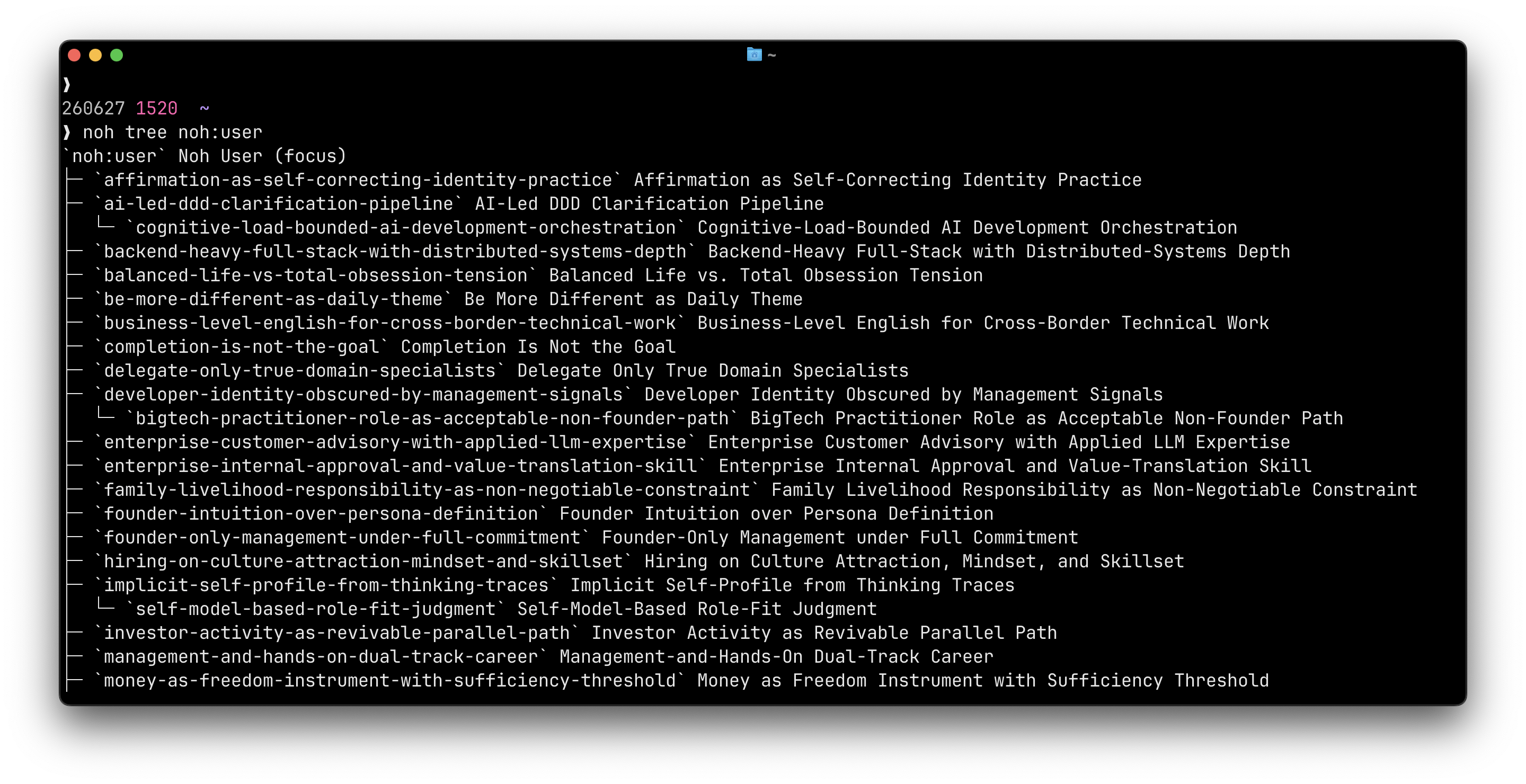
The resume was never the point
Here is the thing I didn't expect. The resume — the document — turned out to be the least interesting output.
What I actually got was myself, as reusable material. The next time any agent works with me, it reads this — noh core for the compressed me, noh ls and noh cat for the details when it needs them. Drafting a resume for a specific role, writing a self-introduction, checking my background against a job description — all of it now pulls from the same place. I built it once. I keep using it.
Try it
After installing nohmitaina, open Settings and enable the agent CLI. That installs the noh command and the skill for the agents you use.
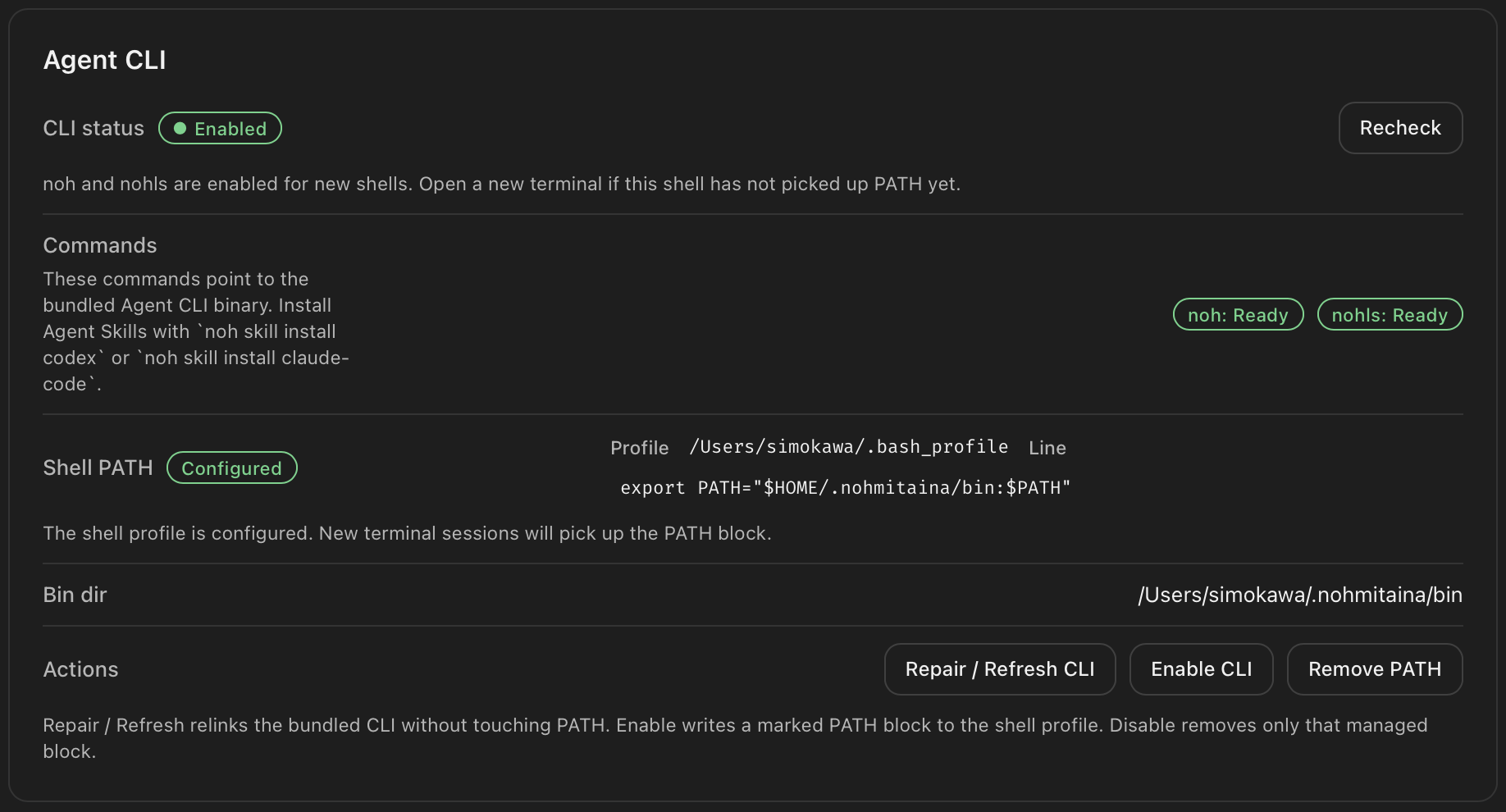
From then on, if you already use Claude Code, Codex, or any agent that runs a skill: just ask it to interview you. That's it.
Download for macOSA note on honesty: this is one way to use nohmitaina, not its main purpose. The point of the editor is to write, let the AI distill what you wrote into concepts, and keep the part that matters. What an agent writes is saved as an AgentNote, kept separate from your own words — you can always tell your thinking from the AI's. Everything stays on your disk.